I Stopped Layering Exports by Hand to Build Our 13-Week Cash Forecast
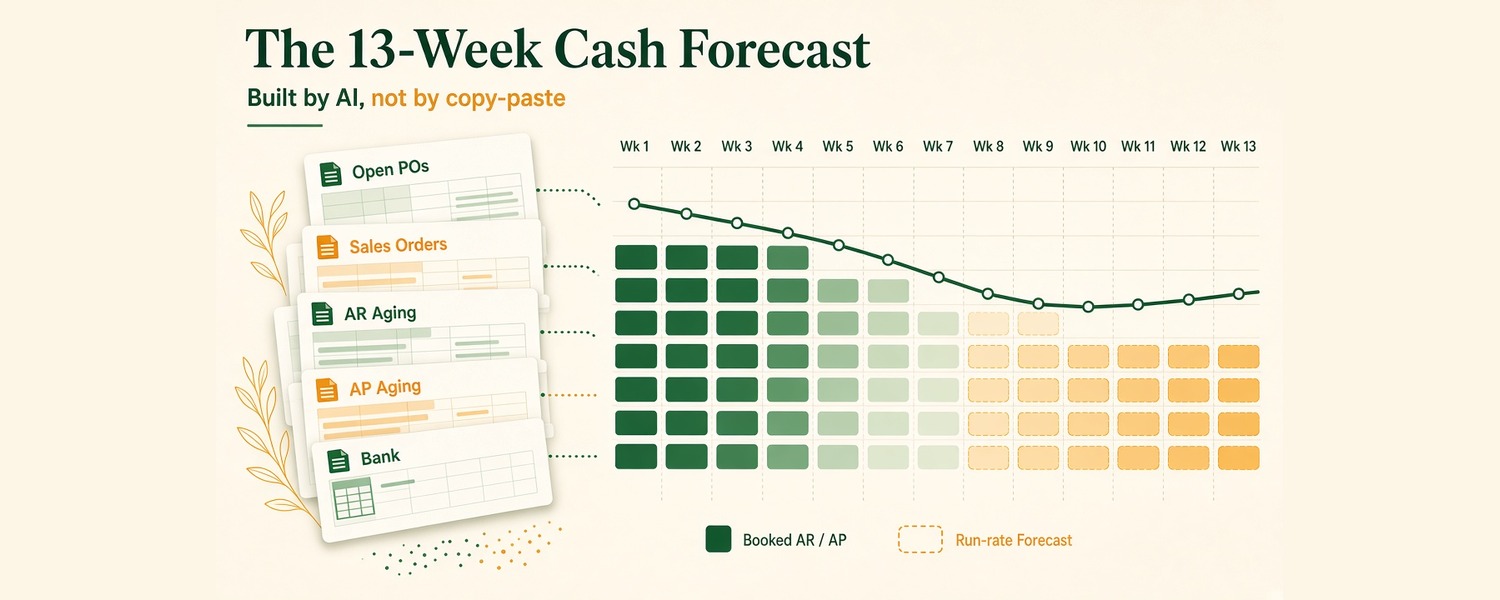
If your team builds a rolling 13-week cash forecast, you know the weekly ritual. Someone exports a stack of reports from the ERP and layers them into a spreadsheet, week by week.
For me, that meant open purchase orders, open sales orders, AR aging, AP aging, bank balances, and the line-of-credit balance, every week. Then I had to marry the open AR and AP to a forecast once those items ran off later in the horizon.
It was the same exports and the same copy-paste every week, and every week it was a chance to double-count a bill or leave a hole where collections should still be coming in.
So I built an AI skill to do the assembly. A human still signs off on every number.
What a 13-week cash forecast is
It’s a direct cash view, not a P&L. You start with cash in the bank, add what you expect to collect, subtract what you expect to pay, and land on an ending balance for each of the next 13 weeks. If you have a line of credit, you also track the drawn balance and the room still left on the line. The invoices and bills already in the ERP carry the early weeks. The later weeks only work if you have a clean handoff from those booked items to a forecast.
The old way
Every week looked the same. I would export the open orders, the AR and AP aging, and the bank and line balances from NetSuite. I’d paste them into a workbook, drop each open invoice and bill into the week I thought the cash would move, and then fill the rest of the 13 weeks once the booked items ran out.
The last step was the messy one. If I stacked a run-rate on top of invoices that were still open, I double-counted cash in. If I stopped when the aging report ran out, cash fell off a cliff around week 9, even though the business was still collecting and paying every week.
The new way
The skill runs the whole build from start to finish:
- It pulls the source data directly. Open AR, open AP, open sales orders, open purchase orders, bank balances, and the line balance come out of NetSuite. There are no manual exports.
- It places the booked items first. Open invoices, bills, sales orders, and purchase orders land in the weeks they should turn into cash.
- It fills the rest of the horizon without double-counting. As booked items run off later in the 13 weeks, the forecast fills only the gap. If a week already has enough booked bills to cover normal vendor spend, nothing gets added. If it’s light, the forecast tops it up to the normal level. Collections work the same way. Each week gets at least its normal level of cash in, based on recent history and seasonality, and booked invoices count toward that level instead of being stacked on top of it. That is what kills the week-9 cliff.
- It forecasts by cash channel, not by P&L line, so vendor payments, card payments, payroll, and auto-debits each have their own line, the way cash leaves or enters the bank.
- If we have a balance on the line, it models a sweep (surplus can pay the line down, a shortfall can draw). I watch total liquidity, cash plus availability, not ending cash alone, because paying the line down shouldn’t look like a forecast miss.
- It builds the workbook and freezes a snapshot of that week’s forecast. It’s read-only. It never posts anything to the ERP.
Trust, but verify
I didn’t hand this over on day one. I tied the open AR and AP in the model back to the source reports, and I started grading each elapsed week against the cash that hit the bank, by channel.
Only after that did it become the way we build the forecast. Now my job is reviewing the output, not assembling the exports. When a channel misses, I look at why, and I only change an assumption when the miss repeats.
What I’d tell another controller
- Start with the exports you already run every week. The skill should pull the same data you used to download by hand.
- Write the handoff rule down explicitly. Booked items come first, and the run-rate only fills what is still unbooked.
- Grade last week’s forecast against actual bank activity, by channel. The model gets better only if you look at the misses.
- Keep it read-only. Automate the forecast before you ever let AI touch the books.
The result
A weekly build that used to take 4-5 hours of exports and layering is now an hour of review. The skill has been running for 14 weeks, and the later weeks no longer fall off a cliff when open AR and AP run out.
If your team still builds a 13-week cash forecast by exporting aging reports and open orders and pasting them into a spreadsheet, this is one of the best first automations you can pick. It’s the same work you already do. It just shouldn’t live in a stack of CSVs.
That’s exactly the kind of work I help small and mid-size businesses automate at Books & Bots Advisory: booksandbotsadvisory.com.
Originally published on X by @BooksAndBotsAI on Nov 22, 2026.
Want a cleaner, faster close?
Tell me about your books and your month-end process. I'll follow up to set up a discovery call.