I Turned a 4-Hour Borrowing Base Certificate Into a Few Minutes of Review
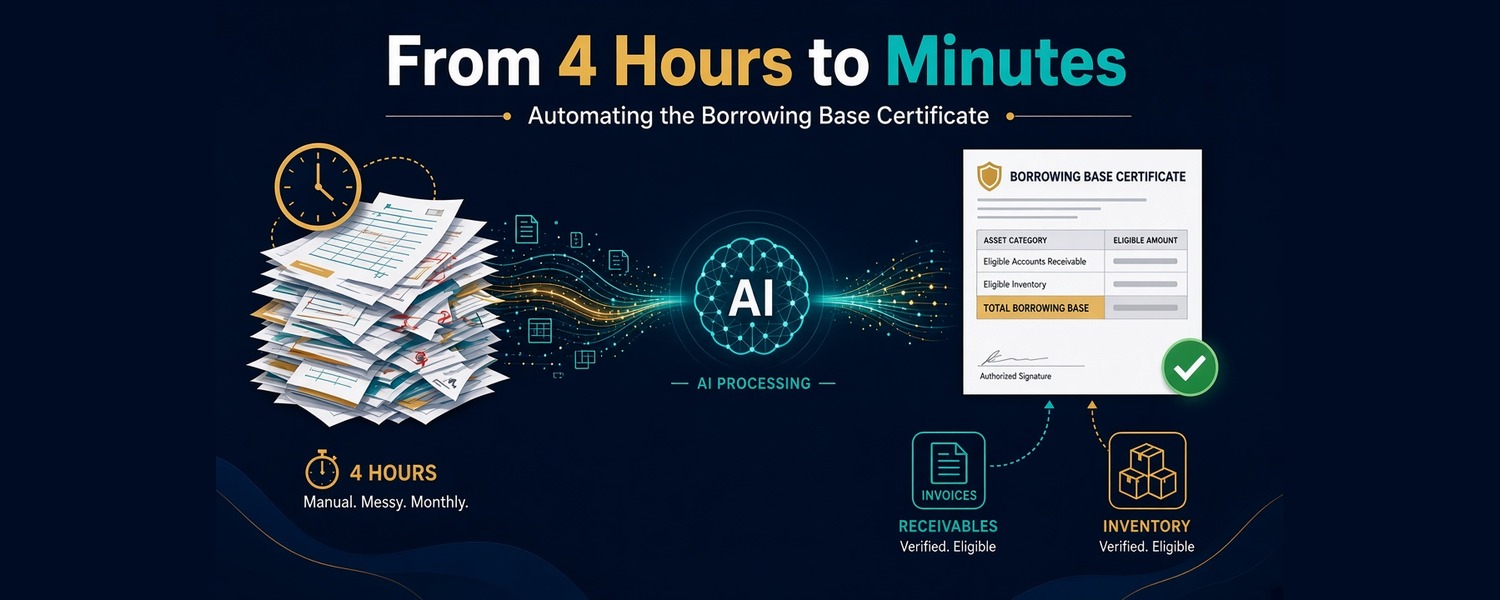
If your company borrows on an asset-based line of credit, you know the monthly ritual. The books close, and then someone on the finance team spends half a day building the Borrowing Base Certificate for the bank.
For me, that was 2 to 4 hours every month. It wasn’t hard work. It was tedious, repetitive work where one wrong filter could mean telling your lender you have more collateral than you do.
So I built an AI skill to do it. Here’s how it works and what I learned.
What a borrowing base actually is
Under an asset-based loan, the bank lends against your receivables and inventory, but not all of them. Each month you prove what qualifies:
- Eligible AR: your receivables, minus the ineligibles (invoices past 90 days, certain customers, intercompany balances).
- Eligible inventory: stock in approved locations and in sellable condition, minus slow-moving or excess items.
- Advance rates and caps: the bank lends a percentage of each pool, up to a limit.
- Compare to the line: the result is checked against what you actually owe, and you report the excess or deficiency.
The math isn’t complicated. The data wrangling is.
The old way
Every month looked the same. I’d export the inventory valuation, trailing 12-month sales and AR aging from the ERP. Then I’d paste them into a template, re-bucket the aging, tag every location as eligible or not, work out the excess inventory item by item, pull the line balance off the GL, and tie it all back to the balance sheet.
It was the same steps and the same spreadsheet gymnastics every time, and every time it was a chance to make a mistake.
The new way
The skill runs the whole process from start to finish:
- It pulls the source data directly. It runs the inventory, sales and AR reports as of month-end, and queries the GL for the line balance. There are no manual exports.
- It applies the bank’s rules in code. Location and item-status rules decide eligibility. Any location it doesn’t recognize defaults to ineligible and gets flagged, so it never quietly inflates collateral.
- It ages AR from invoice dates. It doesn’t rely on whatever buckets a report happens to show.
- It calculates excess inventory. That’s anything on hand beyond what sold in the trailing 12 months, with an add-back for newer items that haven’t had a full year to sell.
- It builds the bank’s workbook, in the exact tab layout and file naming the lender expects.
- It saves the file, confirms the save, and updates a monthly summary file so the trend is always current.
It’s read-only. It never posts anything to the ERP. It just builds the certificate.
Trust, but verify
I didn’t hand this over on day one. I ran it against a certificate we had already submitted and made it match to the penny on AR, inventory, trailing sales and the line balance. Then I re-ran a later month to make sure the results were repeatable.
Only after that did it become the way we build the certificate. Now my job is reviewing the output, not producing it.
What I’d tell another controller
- Start with a month you’ve already submitted. You have a known right answer, so use it.
- Write the bank’s rules down explicitly. Half the value was turning tribal knowledge into rules anyone can read.
- Make unknowns fail loudly. A new warehouse or item status should stop the process, not slip through.
- Keep it read-only. Automate the reporting before you ever let AI touch the books.
The result
A 2 to 4 hour monthly task became a few minutes of review. The certificate is more consistent than when I built it by hand, and the process doesn’t live in one person’s head anymore.
If your team builds a borrowing base every month, this is one of the best first automations you can pick. It’s rules-based, it repeats every month, and it’s easy to check.
That’s exactly the kind of work I help small and mid-size businesses automate at Books & Bots Advisory.
Originally published on X by @BooksAndBotsAI on Nov 15, 2026.
Want a cleaner, faster close?
Tell me about your books and your month-end process. I'll follow up to set up a discovery call.